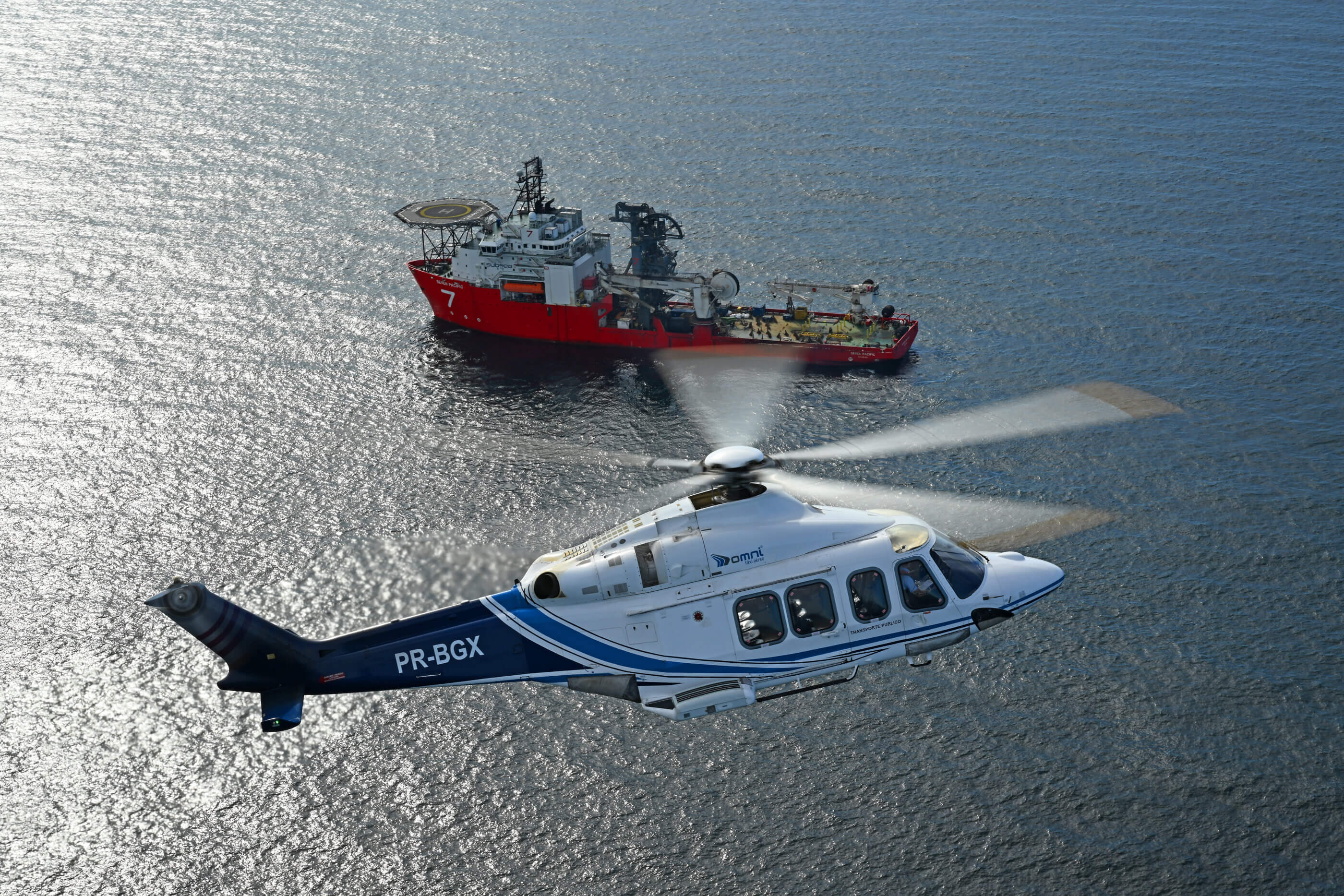

Analysts: Focus on energy security will be lingering impact of war in Iran
Oil prices are expected to quickly recover when the Strait of Hormuz finally reopens, but the lingering impact of its closure will be an increased emphasis on energy security, according to offshore aviation experts.
In early March, fuel prices skyrocketed after Iran closed the key waterway, through which about 25% of the world’s seaborne oil trade passes, in response to U.S. and Israeli military action. Many countries, including much of Europe, also faced the prospect of a supply shortage.
Speaking at Helicopter Investor 2026, Jennifer Whalen, senior vice president and chief financial officer of Bristow Group, said the importance of energy security was one of three major global trends the operating giant is now seeing.
“With all that’s happened in the Middle East . . . there is going to be a big focus on energy security — and that’s probably in other markets outside of the Middle East,” she said. “I think there will be, for the larger oil companies, probably some additional investment in some of these other areas around the world. We have some tailwinds from that — and not only us, our competitors as well, because it should rise all boats.”
Brad Shaen, director of International Aviation Marketing, said crises are a constant in today’s world. “Incidents like what has happened with Iran recently are the new norm . . . but you see how quickly the markets turn and turn to a recovery phase.”
He said operators in the Middle East were the most impacted by the closure of the Strait of Hormuz, but “at the end of the day, it doesn’t really impact our industry.”
“It’s a blip in the screen,” said Shaen. “A year from now, we’ll really look at it as irrelevant — as it relates to specifically our industry. . . . We’re definitely not going to see long-term effects.”
While the soaring cost of oil has resulted in bumper profits for energy companies, Jarle Gaard, senior manager in category logistics at Norwegian company Equinor, said his company didn’t like the high prices.
“We don’t like this volatile pricing because it makes everything uncertain, and it’s difficult to plan for,” he said. “This [crisis in Iran] is one of several lately in the last few years. It’s not something that we appreciate as an energy provider, because it puts the security of the supply under pressure.
“For Europe, in particular, that is the priority for Equinor — to make sure that there is sufficient energy to Europe, and it should also be affordable. So these prices are nice on the balance sheet for the short term, but for the longer term it’s not a positive.”
Jarle said the Hormuz closure hasn’t impacted Equinor’s production plans directly — but that the company’s strategy had changed in recent years, as a result of the war in Ukraine and the aging of the Norwegian Continental Shelf (NCS).
“The plan we have now is the plan for exploration that was decided more than a year ago,” he said. “In actual numbers, the last crisis hasn’t affected us in the volume of projects, but . . . [the ability to] deliver energy to Europe has increased the focus and importance of those projects.”
Jeremy Akel, CEO of Omni Helicopters International, said that Latin America has historically been viewed as an “emerging market” — and as such, more risky to invest in than more mature regions. But he argued that this view is changing.
“What’s been happening over the years — and it’s very much accentuated now by the crisis in the Strait of Hormuz — is all of a sudden Latin America, maybe isn’t as risky as we think it is,” he said. “That has become a bit of a wake-up call, I think, for the world. It’s something a lot of us that worked in Latin America already believed and saw for ourselves, but it’s starting to surface.”
The relative stability in a country like Brazil, he said, means it’s a good place to invest in for energy security.
“Where better to secure supply than countries or a region that is relatively peaceful?” he said. “Brazil, who has big ambitions on oil production and the deployment of capital there, now all of a sudden seems a lot less risky. Geopolitics are impacting the region, but I would say net positively.”
Sebastien Moulin, chief commercial officer of Milestone, said the leasing company has noted particular growth in investment in Brazil, Guyana and Norway.
Despite one of Milestone’s major customers — Aramco — being heavily impacted by the war in Iran, “the demand itself, the market on the oil-and-gas segment has been strong and robust,” he said.
“From an oil-and-gas perspective, and from an operations perspective — for us and for our helicopters — we see it as strong and robust demand for the next few years,” said Moulin.
One of the positives of the current crisis, he said, was that it illustrated an evolution within the industry — with oil companies being more directly engaged with aviation providers.
“Today, there is a lot more focus from the end users to understand the full supply chain and how they can secure the assets for the future of their operations as well,” said Moulin. “I think there was a clear understanding on their side that it’s a critical part of their operation.”
Equinor’s Jarle said whenever the supply chain fails — regardless of who is to blame — the consequences for energy companies are “significant.”
“[The cost of downtime] depends very much on the operations, but the numbers are scary high, and that’s why we are focused on working with the industry to contribute to mend the situation as far as we can,” he said. “That’s why we also changed some of the contract strategies, who we interact with and so on, because it’s nothing that one part of the supply chain can fix alone — this is something that we need to fix together, and we as an end customer are depending on the help of the industry to fix it.”