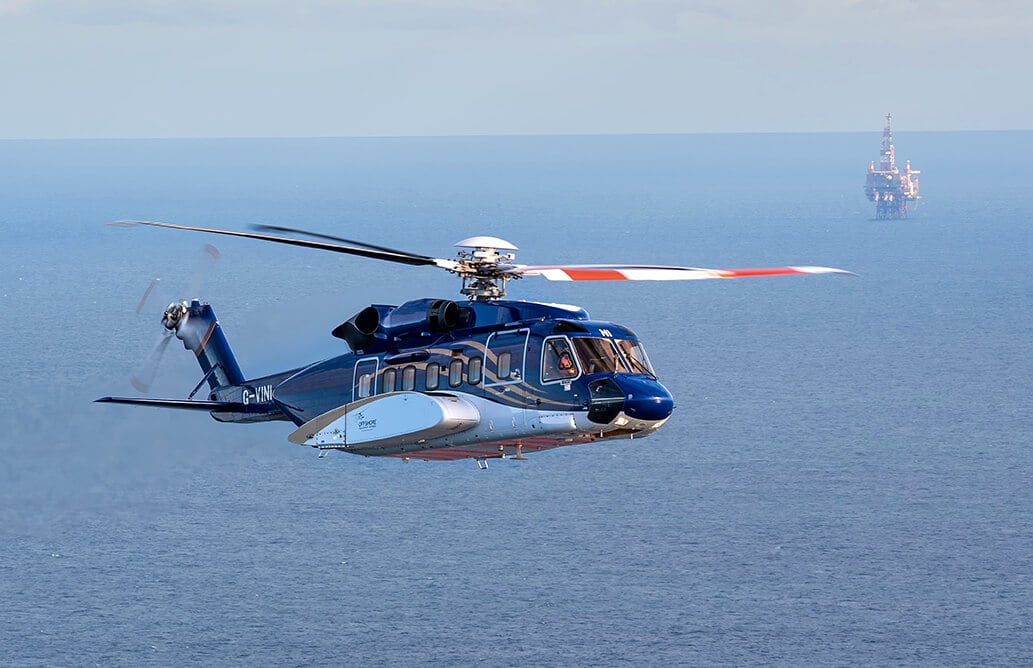

Milestone: S-92 offshore retirement wave delayed to 2030s
By Oliver Johnson | Retrieved from Vertical Magazine
Improved product support and a commitment to the future of the S-92 from Sikorsky will see an anticipated wave of retirement from the type’s offshore role delayed until the 2030s, according to Milestone CEO Pat Sheedy.
Speaking at Helicopter Investor 2026 in London, England, Sheedy said as recently as 2023, the industry in general — including Milestone — had believed a wave of S-92 retirements would have begun by now, as the older models operating offshore reached 20 years in service.
“Maybe we would have thought that, given the issues the aircraft was having in support from 2024 and through 2025 that there would be a rush of super mediums replacing S-92s,” he said. “That has not happened, and the reality is the supply/demand balance here is very, very marginal.
“If you would have looked at charts from a lot of OEMs two years ago, there should be 30 or 40 S-92s retired by now — and they’re not.”
Milestone has been active in trying to develop a secondary market for the S-92 in recent years, playing a leading role in the launch of a firefighting version of the type. The first two S-92 “Fire Raptors” were operated last summer by VIH, flying a little over 1,010 hours.
Meanwhile, energy companies had begun to express a lack of confidence in the supply chain supporting the type, with complaints reaching a peak about two years ago.
Around that time, Sheedy said Milestone had noted Brazilian energy company Petrobras issuing tenders for offshore transport that stipulated super mediums — meaning Leonardo’s AW189 or Airbus’s H175 — only. The leasing company, which owns 17 of about 40 S-92s operating in the region, reached out to Petrobras to understand why the type wasn’t being considered.
“The feedback was they were worried about the availability rates of the 92 . . . [and] they were worried about Sikorsky and their willingness to stand behind product,” he said.
“So we engaged with Sikorsky and Heli-One — we knew we had to be very definitive that this aircraft was going to be supported into the future.”
This resulted in the opening of an S-92 Center of Excellence in Cabo Frio, Brazil, last month — a move Sheedy said would “maintain the competitiveness” of the type in Latin America.
It’s the first Sikorsky -authorized Heli-One S-92 support center in Brazil, and the ninth in the world.
It’s one of several efforts Sikorsky has made over the last couple of years to demonstrate its commitment to the type.
At Verticon 2025, Sikorsky announced the development of the Phase IV gearbox for the S-92. Featuring an auxiliary lubrication system that automatically engages in the event of primary oil pressure loss, the gearbox — the result of a $100 million investment from Sikorsky — is in the final stages of certification.
Earlier this year, Sikorsky also announced plans to produce another five S-92s in the A+ configuration — which features the Phase IV gearbox and the increased power of the GE CT7-8A6 engines — as well as declaring capacity to build up to 12 S-92A+ aircraft each year. The company said the A+ capability will be available as a kit for retrofit to any S-92A already in operation.
“If they bring the A+ kit to market, it certainly will have a place,” said Sheedy. “The reality is the super mediums cannot replace every mission that the S-92 does. There are some relatively young S-92s out there — some of them are only 10 years of age, they will have 10/15 years more to play — and I think upgrading some of those younger S-92s with an A+ gearbox and some of the other modifications that we’re talking about will make economic sense.”
Speaking on a panel at Helicopter Investor London, Brad Shaen, director of International Aviation Marketing, said Sikorsky has done “a fantastic job” of turning around the narrative on the S-92.
“I think we all thought [Sikorsky parent company] Lockheed had given up on the program, and they’ve turned it around,” he said. “It’s a great product. You get in it every morning and it goes, and that reliability is definitely a huge asset to operators.”
Sebastien Moulin, Milestone’s chief commercial officer, said the company’s fleet of S-92s is currently fully utilized until the end of 2027 — and said the experience and reliability of the type have helped bolster its competitiveness against the super mediums.
“The teething issues are real, when you start operations in Norway [for example], when you have de-icing equipment, when you’re flying 100 plus hours per month — you’re putting a lot of stress on the aircraft, and the [S-]92 has been proven in that field,” he said. “Sikorsky has made the right investment. They heard the market. I think those concerns were valid when it came to the support that they were providing at the time, but they’ve turned things around and they’ve invested real money, so they are getting the rewards now.”
John Petkovic, CEO of SMFL Helicopters, said the last couple of years have shown an improvement in the overall global supply chain as well as improving communication with OEMs.
“I think the message has gotten back that availability is key,” he said. “You don’t necessarily need the brightest and newest and shiniest piece of equipment. It’s really about parts on shelf, keeping aircraft flying, customer support, and I think that message has been heard by them, and they’ve responded well to that.”
Despite his belief that the S-92’s retirement from offshore work has been delayed, Sheedy said it is still inevitable — and that Milestone’s strategy is still to replace them with super mediums over time.
“We all know it will happen, but rather than it being 2026, it’s probably 2030/31,” he said.