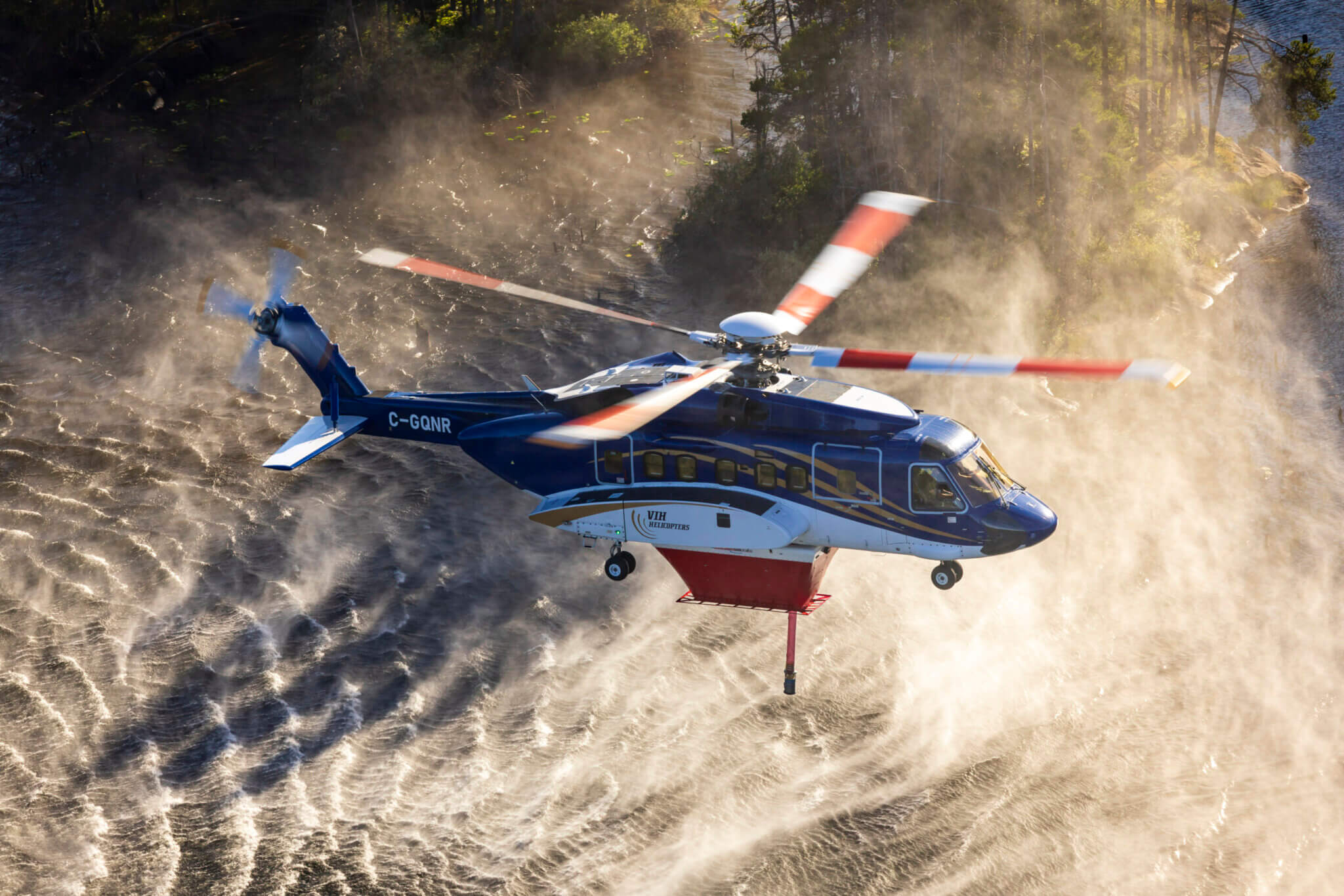

VIH says S-92 Fire Raptor is proving itself as super heavy firefighting workhorse
Written by: Jen Boyer | Retrieved from Vertical Magazine
The summer of 2025 left little doubt of the Sikorsky S-92’s success as the industry’s latest super heavy firefighting helicopter, according to VIH Helicopters. Named the Fire Raptor, the first two firefighting configured S-92s were operated by VIH last summer. Together they flew a little over 1,010 hours, covering several contracts and demonstrating their value.
“The first season went better than we expected, to be honest,” said VIH Helicopters director of operations Shane Palmer. “We’ve ordered a third S-92 to add to the fleet in 2026.”
The Need for Reinvention
Representatives from Milestone Aviation and VIH Helicopters came together to share the success of the first S-92 Fire Raptor during the recent CHC Safety & Quality Summit in Vancouver. During the presentation, they outlined the process from initial idea to execution.
The typical primary mission life on an aircraft like the S-92 is around 20 years, especially when operated in harsh environments for missions like offshore oil-and-gas transport, which is what most S-92s in operation today fly. It’s around this age that the cost of operation tends to increase, leading operators to replace their aircraft, explained Kieran Hannan, chief technical officer at Milestone.
When reaching 20 years of age, S-92s still have thousands of hours remaining before their mandated 30,000-hour life limit. Given the first S-92 was certified in 2004, Milestone estimates more than 110 of the aircraft are poised to move into second lives from offshore operations by 2029.
As the owner of the world’s largest fleet of S-92s, Milestone was motivated to find viable second life missions for the aircraft. With demand for larger multi-mission firefighting aircraft increasing, the S-92 was positioned as an ideal solution.
Hannan highlighted the many aspects of the aircraft that led Milestone to explore positioning the aircraft for firefighting. The aircraft is still technically in production and is fully supported by Sikorsky, as are the aircraft’s GE CT7-8A engines. The type has proven itself with more than 2.6 million flight hours, with data from every one of those hours collected by Sikorsky to better support the aircraft. It boasts a 150-kt speed even at full capacity and a four-hour fuel endurance, allowing it to travel to remote fires and remain on station longer than other Type 1 aircraft before returning for fuel.
Its multi-mission capabilities include the ability to transport up to 19 passengers, potentially carry over 10,000 lb. of cargo internally or externally, and operate with either a belly tank or cargo hook. As a certified aircraft, it also holds an advantage over public use aircraft in terms of passenger carrying rules, Hannan said.
Creating the ideal firefighter
Milestone partnered with Australia-based designer Helitak Firefighting Equipment to develop and certify the Helitak FT5000 for the S-92. It’s a collapsible belly-mounted tank that can carry 1,320 gallons (5,000 liters) and includes a 53-gallon (200-liter) foam retardant capacity. Fitted with the Helitak HP6000 hover fill pump, the tank fills in under a minute. The FT5000 was certificated by the FAA in July 2024, and received Transport Canada certification shortly thereafter.
“We chose to futureproof the tank so as new technology becomes available for the S-92, we can carry more water without having to reinvent the wheel,” Hannan said.
How much water the aircraft can actually carry depends on the internal gross weight allowance for the aircraft. For instance, VIH’s aircraft have a 26,500 lb. internal gross weight configuration, allowing it to carry 1,128 gallons (4,270 liters) in the tank with minimum fuel.
Hannan expects the certification of the performance-enhancing VH-92 blades for the S-92 in the next couple of years, and together with Sikorsky’s promised A+ engine will allow the aircraft to lift up to the full tank’s capacity.
The aircraft itself was modified with the addition of robust mounting points to attach the tank, fixed landing gear to replace its retractable gear, utility seating in the interior that can rapidly be removed for cargo transport, the removal of floats and rafts needed in offshore transport, and adjustments to mission avionics.
The Fire Raptor in action
VIH’s Fire Raptors stayed busy all summer, impressing both VIH and its customers, said VIH’s Palmer. “We got the first one toward the end of May. It started off in Alberta, then went to Newfoundland before coming back for a gearbox change and scheduled maintenance. It went right to work after in B.C. to finish off the year before returning Sept. 20. The other aircraft started the first part of June in Alberta for about a month and got picked up by Manitoba the day after it was released from its Alberta contract.”
In some cases, the aircraft wasn’t initially requested but was the only one available. Skeptical customers became true believers.
“Manitoba, for instance, wanted an S-61 for bucket operations, but we didn’t have one available,” Palmer explained. “We offered them the S-92, which was only four hours away, and invited them to try it. We argued it gave them extended range and they needed that for these remote fires in Northern Manitoba. We offered to release them from the contract if they didn’t like it. They initially gave us a seven-day contract, and the aircraft performed so admirably they renewed that contract seven times until the fires were managed.”
The extended fuel range of the S-92 proved crucial for remote operations.
“What this machine does have to offer over our 61 is extended range,” said Palmer. “We can put four hours of fuel on board and stay out there for a lot of good work.
Bringing the S-92 into service at VIH involved considerable preparation. VIH’s sister company, Cougar Helicopters, has considerable experience with the aircraft, and helped with the growing pains. VIH had to add the S-92 to its operations manual and operating certificate, develop a training program, and train its pilots and crews. Overall, the program was an overwhelming success.
“Everybody that we trained loves it, because it’s so nice to fly and provides a reduced workload,” Palmer said. “You have to hand fly older aircraft, and having the ability to utilize the automation on the S-92 gives the pilot time to think ahead, prepare for the mission, dial in frequencies, and such. You become more relaxed and focused, and safer. And it reduces fatigue.”
While Canadian contracts were focused solely on water drops, Palmer sees more multi-mission opportunities globally. VIH is bidding on contracts around the world, especially in the southern hemisphere where the aircraft can work during the Canadian off season.
“There are different parts of the world that want a multi-purpose capability and want a type certificated helicopter that can haul people,” Palmer noted. “It’s a great aircraft for firefighting but is also valuable in disaster relief and search and rescue. It’s a real multi-purpose helicopter.”